Loading...
Helicopter Charter
Helicopter charter solves the problem fixed-wing aircraft cannot: distance is short, the destination has no runway, or the last ten miles are the whole point.
I.
About helicopter charter
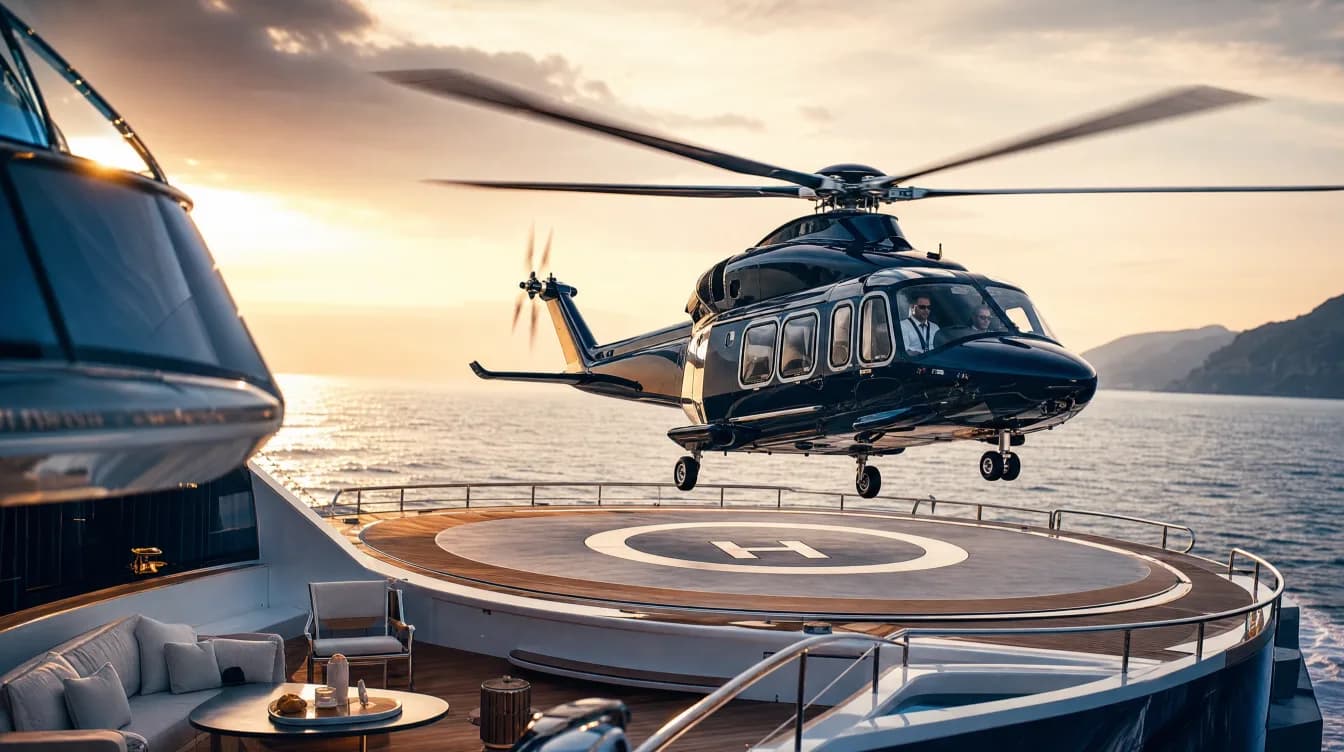
A city-center transfer that takes ninety minutes by car takes eight by helicopter. Our helicopter charter work splits into three missions: airport-to-city transfers for executives connecting from long-haul jets, access flights to remote sites such as islands, yachts, estates, and construction locations, and aerial work including filming and survey flights. The aircraft matters more in rotary charter than almost anywhere else in aviation. For VIP passenger work we quote twin-engine types as the default: the Leonardo AW139 seats up to 10 passengers in corporate configuration with a cruise around 165 knots, the Airbus H155 and Sikorsky S-76 carry 6 to 8 in comparable comfort.
Twin-engine machines are the standard for overwater sectors and dense urban operations because they can continue flight after an engine failure, and several major cities effectively require them for downtown helipad access. Single-engine types like the Airbus H125 remain the right tool for utility work and short daylight hops where regulation permits.
II.
How it works
Range planning is different from jets. Practical sector length for most passenger helicopters is 150 to 350 nautical miles before refueling, and weather minima are stricter, particularly for offshore and mountain work. We plan every rotary mission with fuel alternates and a fixed-wing fallback where geography allows, because a grounded helicopter with no plan B is a missed closing. Operators are held to the same certification standard as our jet partners: an air operator certificate under the local authority, FAA Part 135 in the United States, with third-party audit checks through ARGUS or Wyvern where coverage exists.
For yacht and offshore transfers we additionally verify helideck certification and crew currency in overwater operations, including HUET training where the sector requires it.
III.
What to expect
Pricing runs by the flight hour with daily minimums for aircraft positioned away from base. A twin-engine VIP machine typically books at several thousand dollars per hour; a short transfer often costs less than clients expect because the airborne time is minutes, not hours. Where the mission is long-distance, we will tell you plainly when a light jet plus a short helicopter connection beats a rotary-only routing on both cost and time. For recurring helicopter charter needs, such as a weekly commute to a coastal property, we negotiate block rates that bring the per-flight cost well below spot helicopter charter pricing.
Send the sector, dates, and passenger count, and a rotary quote comes back the same day.
IV.
What’s included
- —Twin-engine VIP fleet: AW139 up to 10 seats, H155 and S-76 for 6-8 passengers
- —City transfers in minutes: 8-minute sectors replacing 90-minute drives
- —Overwater and yacht transfers with helideck certification checks
- —Crew overwater currency verified, including HUET where sectors require it
- —Part 135 / local AOC operators with ARGUS and Wyvern screening
- —Practical sector planning within 150-350 nm with fuel alternates set
- —Fixed-wing fallback planned for every weather-exposed rotary mission
Also from us
Related services
- Group Charter FlightsGroup charter flights move 20 to 300+ people on one aircraft, on your schedule, to your airport.
- Fractional Jet OwnershipFractional jet ownership means buying a share of a specific aircraft, typically 1/16th to 1/2, and receiving a guarantee…
- Corporate Jet CharterCorporate jet charter is business jet rental structured around how executive teams actually travel: multi-city itinerari…
Frequently Asked Questions
Everything you need to know about our services.
Helicopter charter is quoted per flight hour, and the rate scales with the machine. Light single-engine helicopters suited to short transfers and sightseeing sit at the accessible end of the market; twin-engine executive helicopters with leather interiors and IFR capability cost several times more per hour. Your quote also reflects landing fees at private helipads, waiting time if the helicopter stays with you between legs, and repositioning if the aircraft must fly to your departure point. For typical city-to-airport transfers the flight time is short — often 10 to 30 minutes — so even premium helicopters can be surprisingly reasonable per trip compared with the road time saved. Send us your route and passenger count, and we'll return exact options within minutes.
Helicopter charter solves the last-mile problem that fixed-wing aviation can't. The most common use is airport transfer: connecting a private jet arrival to a city-center helipad, turning an hour of traffic into a ten-minute flight. Beyond transfers, clients charter helicopters for multi-site business days — visiting several facilities or properties in a single morning — for events with dedicated helipads such as races and regattas, for aerial photography and site surveys, and for reaching destinations with no runway at all: islands, resorts, yachts equipped with helidecks, and remote estates. Capacity typically runs from three to eight passengers depending on the type. If your itinerary involves any point a road serves badly, a helicopter usually serves it well.
Ready to fly?
Send us your route, dates and passenger count. We come back with a quote from vetted operators, usually within the hour.